The AI Layoff Trap: Why the Machine Age May Lead Back to the Soil
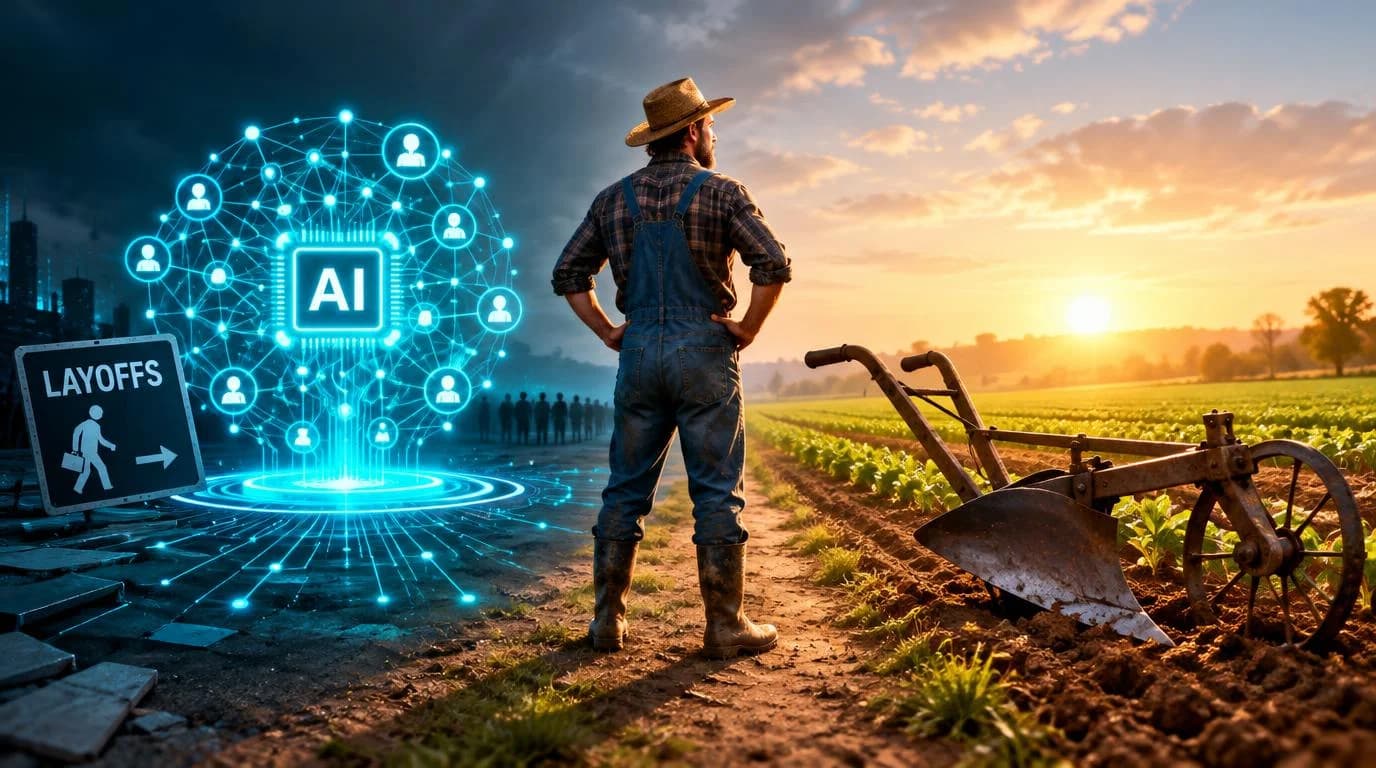
The AI Layoff Trap: Why the Machine Age May Lead Back to the Soil
AI layoffs, the economics of doing less, and a two-thousand-year-old Tamil argument for the work that feeds us
بِسْمِ ٱللّٰهِ ٱلرَّحْمَٰنِ ٱلرَّحِيمِ In the name of Allah, the Most Merciful, the Most Compassionate.
🤖 Introduction: The Layoff That Didn't Pay Off
In 2026, the corporate world found a new way to announce a brighter future: cut the people who were supposed to build it.
AI was cited in wave after wave of restructuring. Investors were told the savings would fund transformation. Employees were told to adapt. Then the results arrived. Productivity gains stayed thin. Rehiring followed. Institutional knowledge walked out the door and did not come back.
The phrase "AI layoff trap" has been used in two different ways this year. One is a Wharton model showing how rational firms get stuck in an automation arms race that harms everyone. The other is a Harvard Business Review and Forbes warning about cuts made in anticipation of AI, not because of it.
Both point to the same question. If machines absorb cognitive work faster than the economy reabsorbs the people who did it, where does work go? The usual answer is "new jobs." Nobody has named them with confidence. Another answer is older: back to the land.
Not a prediction. A possibility Thiruvalluvar took seriously two thousand years ago. His farming chapter does not treat agriculture as a quaint beginning. It treats it as the foundation.
📉 What the Research Actually Says
Start with the firm-level evidence.
In January 2026, Harvard Business Review published a survey of 1,006 global executives. AI was behind at least some layoffs, but the cuts were almost entirely anticipatory — based on what AI might do, not what it had done.
By August, the evidence had sharpened. Tom Davenport and his co-authors argued that early AI-driven layoffs often failed to deliver returns, exposed gaps in organizational knowledge, and created new demands for human oversight. One survey of HR leaders found that 55% said their layoffs were not worthwhile because AI required more supervision than expected. One in three reported losing critical skills along with the people who left.
Mark Ma's team at the University of Pittsburgh analysed millions of job-satisfaction reviews, thousands of financial reports, and hundreds of AI investment and layoff announcements over five years. The pattern is a feedback loop: announce AI investment, face pressure to show returns, cut headcount to lower costs, then wonder why productivity never arrives.
In Ma's words, "AI-driven layoffs and the resulting job insecurity are actively destroying the very conditions needed for AI to make workers more efficient." Employee sentiment toward AI is one of the strongest predictors of whether AI improves productivity. Fear is not a side effect. It is an input.
The market is not impressed either. The average stock reaction to these layoffs was close to zero; more than half were negative or negligible. Revelio Labs found that companies blaming AI had actually grown AI headcount by 11% over two years — and still lagged peers in adoption.
One caveat. Goldman Sachs estimates AI reduced monthly U.S. payroll growth by only about 16,000 jobs over the past year, adding roughly 0.1 percentage points to unemployment. That is a drag, not a collapse. We are early. The trap is not that the robot apocalypse has arrived. The trap is that the story of it is already shaping decisions that are hard to reverse.
🕳️ The Trap Has Two Floors
The firm-level trap is easy to see once you name it. The economy-level trap is harder.
In a Wharton working paper titled "The AI Layoff Trap," Brett Hemenway Falk and Gerry Tsoukalas show that a firm captures the full saving from automation but bears only a fraction of the demand loss it creates. The rest falls on other firms. Every company is tempted to cut a little more than its rivals. The result is an automation arms race that displaces workers far beyond what is collectively rational.
More competition and better AI do not fix it; they amplify it. Universal basic income, upskilling, and wage adjustments do not fix it either. The authors argue that a Pigouvian tax on automation — one that prices the external damage — can correct the incentive at its source. Agree or not, the diagnosis matters: this is a coordination problem, not a machine problem.
Inside a company, the trap tightens in three ways.
Knowledge leaves. The people who know why a process exists, which customer is difficult, and where the real bottlenecks sit are often the same people a headcount target marks as redundant. AI can absorb tasks. It cannot absorb context.
Culture curdles. When cuts are blamed on AI, survivors learn that enthusiasm for AI may make them the next case study. Experimentation goes underground. The technology that was supposed to make the organization faster becomes something people quietly avoid.
Demand erodes. Workers are also customers. A layoff is a wage cut somewhere else, and a wage cut is a revenue cut in disguise. Henry Ford understood this a century ago, which is why he paid workers enough to buy the cars they made. The AI version is less poetic: if you automate away the incomes that buy your products, you have optimized yourself into a smaller market.
A company can cut its way to a smaller payroll. It cannot cut its way to a larger future.
🌾 Where Does the Work Go?
Every major labour transition had a destination. Agriculture shed workers into factories; factories shed them into offices and services. The move was painful and generation-long, but there was somewhere to go.
The AI transition has no obvious destination. The International Labour Organization estimates that one in four jobs worldwide has some exposure to generative AI, while stressing that transformation is more likely than replacement. That is reassuring in aggregate and useless in the individual case. "Your job will be transformed" is not a plan for the person being transformed out of it.
The standard answer is reskilling. Learn a trade. Become a plumber. Mark Ma notes the flaw: if millions of displaced office workers all train for the same trades, the supply rises, the market tightens, and the safe harbour becomes crowded. Reskilling is necessary. It is not a destination.
At the edges, another signal is appearing. Australia's $101 billion agriculture sector reportedly has six jobs for every agriculture graduate. Students who watched entry-level office roles shrink are turning toward agricultural science. In Maine, a food-system group asked this August: "What if the future of work brings more of us back to food?"
A modern return to the land would not mean mass subsistence farming. It would mean thickening the middle of the food economy: small and midsized farms, regional processing, cold storage, equipment repair, local distribution, and the marketing and compliance work that lets small producers reach local buyers. Some would farm. Many more would work in the system around farming. Call it a new agrarian margin, not a new agrarian era.
It would also hit hard limits. Land is expensive. Capital is scarce. Water is contested. Climate is unstable. Farming is not a therapy retreat; it is weather, debt, blight, broken equipment, and markets that do not care about your intentions. M. Anne Visser, who studied automation in California and Washington orchards for three years, put it well: "Replacing a task on a farm is not the same as replacing a job." Even automated farms need people who can read the land, interpret the machine, and judge when the algorithm is wrong.
So the future is not "AI utopia" versus "everyone becomes a farmer." It is a choice between augmentation, the trap, and a landward correction that re-localizes some work around food, care, repair, and place. The first and third are worth aiming for. Both require what the trap refuses to provide: patience.
📜 Thirukkural, Chapter 104: The Political Economy of the Plough
Thiruvalluvar placed his farming chapter — உழவு (Uzhavu) — in the Porutpal, among chapters on nobility, honour, shame, and poverty. That placement is itself an argument. Farming is not a rural relic. It is political economy.
சுழன்றும்ஏர்ப் பின்னது உலகம் அதனால் உழந்தும் உழவே தலை.
"Wherever it whirls, the world must follow the farmer. Thus, despite hardship, farming is foremost." — Kural 1031
Notice the word உழந்தும் — even after suffering. Thiruvalluvar does not call farming easy. He calls it primary. The world may cycle through every trade imaginable, but it ends up behind the plough, because someone has to eat.
உழுவார் உலகத்தார்க்கு ஆணிஅஃ தாற்றாது எழுவாரை எல்லாம் பொறுத்து.
"Farmers are the linchpin of the world, for they support all others who cannot till." — Kural 1032
The image is mechanical, not sentimental. An axle-pin is small, hidden, and load-bearing. Remove it and the cart collapses. That is a useful way to think about essential work: its value is not in its visibility, but in what it holds up.
Two more couplets sharpen the point. Kural 1033 says that those who live by ploughing and eating truly live, while the rest bow and follow — an argument about agency, not moral hierarchy. Kural 1036 says that if the farmer's hands fall idle, even those who claim to have renounced everything will lack. The renunciate's detachment is subsidized by the farmer's attachment to the soil. AI does not abolish that dependency. It can make it less visible, and invisible dependencies are the ones we neglect.
ஏரினும் நன்றால் எருவிடுதல் கட்டபின் நீரினும் நன்றதன் காப்பு.
"Better than the plough is manure; after weeding, better than irrigation is guarding." — Kural 1038
This is the couplet I would hand to every board of directors. Thiruvalluvar ranks the farmer's tasks, and the tool is not at the top. Ploughing is necessary. Fertility is better. Weeding is necessary. Protection is better than irrigation. A company that buys the most advanced AI but starves its people of training, trust, and time is not a modern enterprise. It is a bad farmer with an expensive tractor.
இலமென்று அசைஇ இருப்பாரைக் காணின் நிலமென்னும் நல்லாள் நகும்.
"Mother Earth laughs at the sight of those who sit idle and plead poverty." — Kural 1040
This verse is easy to misread, and it has been misused. It is not a verdict on anyone who has lost a job to forces beyond their control. The "idle" here is the person who has land, health, and opportunity and still refuses to act, using poverty as an excuse. Read alongside the rest of the chapter, it is a rebuke to resignation — not to the unemployed. The earth does not laugh at the displaced. It laughs at those who could plant and will not.
Taken together, the chapter makes a claim every generation has to re-learn: a society that treats its base as backward will eventually find its base missing. The plough is not the past. It is the substrate.
🕋 An Islamic Perspective: Work as Worship, Land as Trust
The Qur'an does not romanticize farming either. It treats the earth as usable, provision as a gift, and stewardship as a trust.
"He it is who has made the earth easy to live upon: go about, then, in all its regions, and partake the sustenance which He provides: but [always bear in mind that] unto Him you shall be resurrected." — Surah Al-Mulk (67:15)
The earth is ذلول — tractable, spread out, made ready for human use. Work is a form of walking through it. Provision comes from God, but seeking it is the human vocation. The verse ends with resurrection, a quiet check on every economy: the market is not the final court.
"And when the prayer is ended, disperse freely on earth and seek to obtain [something] of God's bounty; but remember God often, so that you might attain to a happy state." — Surah Al-Jumu'ah (62:10)
Worship and work are not opposites. They are rhythms. The same day contains both. The command to remember God often is precisely what prevents work from becoming an idol — or the quarterly return from becoming the only measure of a human life.
The Prophet ﷺ made the dignity of manual labour explicit:
"No one eats better food than that which he eats from the work of his own hands." — Sahih al-Bukhari 2072
The narration names Prophet Dawud, who ate from the work of his own hands. The hierarchy that places office work above soil work is not a hierarchy Islam recognizes. Dignity comes from effort, honesty, and usefulness — not from the distance between your hands and the ground.
And then there is the hadith that captures the spirit of farming better than any policy paper:
"If the Hour is established while one of you has a sapling in his hand, let him plant it." — Musnad Ahmad, graded authentic
A farmer plants trees whose shade they may never sit in. That is the opposite of the quarterly-earnings mindset that drives the AI layoff trap. It is also the opposite of despair. The act of planting says that the future belongs to God, but the present belongs to the person who still has a sapling in their hand.
🧭 What a Humane Correction Looks Like
The worst version of a return to the land is a desperate retreat: displaced people with no capital, no land, no training, and no market, told to "go farm" as if farming were a consolation prize.
The better version is a set of deliberate choices.
- Make land accessible. Community land trusts, long leases, and credit for first-generation farmers matter more than speeches. Without secure tenure, nobody invests in soil.
- Build the middle of the food chain. Regional processing, cold storage, seed banks, equipment repair, and local distribution are the unglamorous infrastructure that makes small farms viable. This is where most of the jobs would actually be.
- Fund transitions, not just training. Paid apprenticeships, wage insurance, portable benefits, and mentorship turn reskilling from a slogan into a bridge. A certificate without a job is a receipt for hope.
- Use AI for the small producer. Bookkeeping, crop planning, compliance, and market linkage are exactly the burdens that crush small farms. AI can serve decentralization as easily as consolidation — if someone builds for it.
- For companies, drop the headcount target. Redesign work instead of subtracting people. Measure employee sentiment, retention, and capability alongside cost. Treat the knowledge that walks out the door as a liability, because it is.
- For policy, coordinate. The Wharton paper's automation tax is one lever. Shorter work weeks, wage insurance, portable benefits, and public investment in regional food systems are others. The precise mix is a matter for democratic argument. The absence of a mix is not neutrality; it is a choice to let the trap run.
| The trap | The correction |
|---|---|
| Cut headcount to show returns | Redesign work to create returns |
| Treat people as costs | Treat people as soil |
| Measure quarterly savings | Measure capability and trust |
| Automate tasks, abandon workers | Automate tasks, redeploy workers |
| Centralize, extract, scale | Localize, steward, sustain |
🌱 Conclusion: The Plough and the Prompt
The AI layoff trap is not a story about machines getting too good. It is a story about institutions getting too impatient. The technology is real, and its gains are real. But the rush to convert those gains into headcount cuts has produced a self-inflicted wound: lost knowledge, frightened teams, stalled adoption, and a stock market that mostly shrugs.
The deeper question is older than AI. What is work for? Who is it for? And what do we owe the earth and each other?
Thiruvalluvar answered with a chapter that begins with hardship and ends with a laughing earth. His farmers are the original essential workers: the people who carry the world while everyone else is convinced they are the ones doing the carrying. If the machine age sends some of us back toward the soil, it should not be a punishment or a retreat. It should be a correction — with land, capital, dignity, and a market. It should be a choice.
AI can write the report. It cannot eat the rice. Someone still has to grow it.
However the economy changes, the deeper questions remain. The Qur'an speaks to them with a clarity no earnings call can match. Read the Quran in your language with Al Quran Multilingual — a free Quran application for Android, iOS, and desktop, with a downloadable Quran PDF for offline study.
- Android: Al Quran Multilingual on Google Play
- iOS / macOS: Al Quran Multilingual on the App Store
- Desktop: Al Quran Multilingual on GitHub
- Web: alquranjino.online
Primary sources: Joe McKendrick, "Avoiding The AI Layoff Trap," Forbes, 30 August 2026; Faisal Hoque, Tom Davenport & Paul Scade, "AI Transformation Requires Redesigning Work, Not Cutting Roles," HBR, 28 August 2026; Brett Hemenway Falk & Gerry Tsoukalas, "The AI Layoff Trap," Wharton working paper, 2026; Mark Ma, The Conversation, 12 August 2026; Maine Food & Farm Strategy, August 2026; UC Davis orchard automation study, October 2026; Thirukkural, Chapter 104 (Uzhavu), kurals 1031, 1032, 1033, 1036, 1038, and 1040 — Tamil text and translations; Qur'an translation by Muhammad Asad via Al Quran Multilingual.

Jinosh Nadar
Founder of Al Quran Multilingual. Dedicated to making Islamic wisdom accessible.