Bison Kaalamaadan Movie Review: When Cinema Distorts Reality and Amplifies Division
Bison Kaalamaadan Movie Review: When Cinema Distorts Reality and Amplifies Division
November 1, 2025
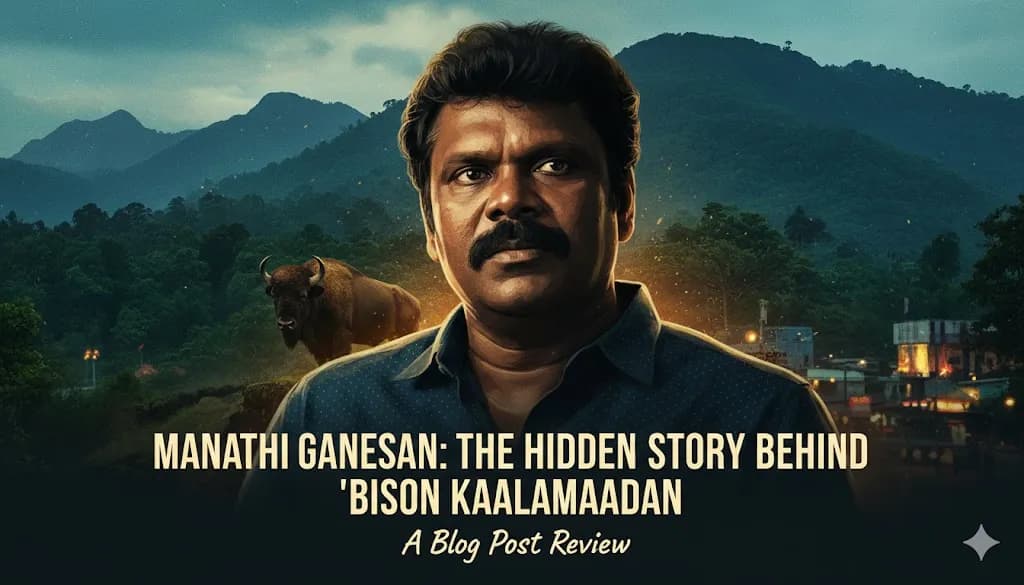
The Tamil film Bison Kaalamaadan, directed by Mari Selvaraj and starring Dhruv Vikram, has been creating waves at the box office since its October 17, 2025 release. Marketed as a sports drama inspired by the life of legendary kabaddi player Manathi Ganesan, the film has also generated intense debate for its portrayal of history, caste relations, and social dynamics in southern Tamil Nadu.
As someone whose parents lived in Nazareth, Thoothukudi—the very region depicted in the film—and who belongs to the Nadar community, I feel compelled to examine the growing gap between cinematic fiction and lived reality. Manathi Ganesan himself belongs to the Devendra Kula Vellalar community. This difference in community identity is stated here only for clarity of perspective—not because it implies conflict. Different communities do not automatically mean hostility, and presenting them as eternal enemies is both inaccurate and dangerous.
This review examines not just the film’s artistic choices, but its responsibility to truth, its impact on communal harmony, and the troubling precedent it sets when sensationalism overtakes accuracy. More importantly, it reflects on what timeless ethical sources—the Thirukkural and the Quran—teach us about equality, brotherhood, and rejecting caste-based hatred.
Who Is the Real Manathi Ganesan?
Before analyzing the film’s failures, it is essential to understand the real story that deserved to be told with honesty and dignity.
From Rural Poverty to National Glory
Manathi P. Ganesan was born in the late 1970s in Manathi village, Tuticorin district (now Thoothukudi), into the Devendra Kula Vellalar community. His family lived in deep poverty. His parents, Perumal and Mangalam, raised seven children in circumstances where even attending school meant walking several kilometers daily.
From the age of eight, Ganesan displayed an intense passion for kabaddi. He practiced relentlessly on village grounds, trees, and walls—an unconventional training that later evolved into his legendary headbutt technique, enabling him to outmaneuver stronger and taller defenders.
Multi‑Sport Excellence and Determination
Ganesan’s path was far from smooth. Due to repeated school changes and financial hardship, his sporting journey took several turns. After failing ninth standard, he moved to Sayarpuram Hopes School, which lacked a kabaddi team. Rather than quitting sports, he switched to hockey, excelling as a goalkeeper, and also performed exceptionally in athletics, particularly the 100m and 1500m races.
Financial constraints forced him to abandon hockey—equipment costs were beyond his family’s means. A turning point came when his physical education teacher Thangaraj recognized his kabaddi talent, mentored him, and even supported him financially.
By age 16–17, Ganesan was competing at the district level. Within a year, he represented Tamil Nadu, and soon after, India.
Asian Games Gold and Arjuna Award
In 1994, Manathi Ganesan was part of the Indian kabaddi team that won gold at the Asian Games. In 1995, he received the Arjuna Award, becoming one of the very few kabaddi players from Tamil Nadu to receive the honour. He later captained the Indian national kabaddi team.
Today, he continues serving Tamil Nadu sports as an official and mentor, nurturing the next generation of kabaddi players.
Where Bison Kaalamaadan Goes Wrong
1. Geographical and Cultural Inaccuracy
Nazareth and Manathi are real places with distinct cultural, architectural, and religious identities. The temples, rituals, and landscapes shown in the film bear little resemblance to the actual region. Such inaccuracies raise a serious question:
If a film cannot faithfully portray geography and culture, can it be trusted with history and social truth?
The absence of even a single real photograph or visual acknowledgment of Manathi Ganesan further disconnects the film from the person whose life it claims to be inspired by.
2. Caste Narrative Over Sporting Truth
Manathi Ganesan’s real story is about sport, discipline, and resilience. Instead, kabaddi becomes secondary, while caste conflict dominates the narrative. The film underplays:
- His technical mastery of kabaddi
- His multi‑sport excellence
- His Asian Games victory
- His Arjuna Award
What remains is a dramatized caste conflict that overshadows athletic excellence.
This is not Manathi Ganesan’s story. It is a political narrative wearing his name.
3. Manufacturing Conflict
The film presents caste hostility as generational, inevitable, and violent—especially involving the Devendra Kula Vellalar community. While caste discrimination has undeniably existed, turning isolated tensions into perpetual hatred is historically dishonest.
Community difference does not equal enmity. In lived reality, southern Tamil Nadu has largely functioned through coexistence, interdependence, and shared struggle.
The Devendra Kula Vellalar Classification Issue
The demand to classify the Devendra Kula Vellalar community under Backward Classes (BC) instead of Scheduled Castes (SC) is a legitimate constitutional and administrative issue. Though discussed widely, the request was not accepted in 2021, and advocacy continues.
This struggle is about policy and dignity, not violent social hatred. Support has come from leaders across communities, including Seeman (Naam Tamilar Katchi), who belongs to the Nadar community—demonstrating that justice transcends caste identity.
What Sacred Texts Teach About Equality
Thirukkural: Tamil Ethical Foundation
Kural 972 declares:
“All human beings are equal by birth; distinctions arise only from actions.”
Kural 214 reinforces:
“Greatness is not determined by birth, but by virtue.”
Thiruvalluvar’s philosophy directly rejects birth‑based hierarchy.
Quranic Teachings on Brotherhood and Equality
Universal Human Equality
Surah Al‑Hujurat 49:13
“O humanity! We created you from a male and a female and made you into peoples and tribes so that you may know one another. The most noble of you in the sight of Allah is the most righteous.”
🔗 https://alquranjino.online/book/ara_quransimple/49/13
This verse explicitly rejects superiority based on birth, tribe, or community.
Brotherhood and Reconciliation
Surah Al‑Hujurat 49:10
“The believers are but brothers, so make peace between your brothers.”
🔗 https://alquranjino.online/book/ara_quransimple/49/10
Unity Over Division
Surah Aal‑Imran 3:103
“Hold firmly to the rope of Allah together and do not be divided.”
🔗 https://alquranjino.online/book/ara_quransimple/3/103
Diversity as a Divine Sign
Surah Ar‑Rum 30:22
“Among His signs is the diversity of your languages and colors.”
🔗 https://alquranjino.online/book/ara_quransimple/30/22
These verses directly oppose caste‑based hierarchy and inherited hatred.
Conclusion: Truth Over Sensationalism
Manathi Ganesan’s life proves that excellence transcends caste. Bison Kaalamaadan could have celebrated this truth. Instead, it chose distortion over responsibility.
Cinema is powerful. With that power comes accountability. When films rewrite history in ways that divide communities, audiences must respond with critical thinking, ethical clarity, and moral courage.
Let us choose:
- Truth over fiction
- Brotherhood over division
- Human dignity over caste identity
Different communities do not mean enemies. They mean shared humanity.
That is the lesson both Tamil wisdom and Islamic guidance teach us—and the lesson cinema must not forget.

Jinosh Nadar
Founder of Al Quran Multilingual. Dedicated to making Islamic wisdom accessible.