Islam and Dress: Principles, Not Arab Fashion
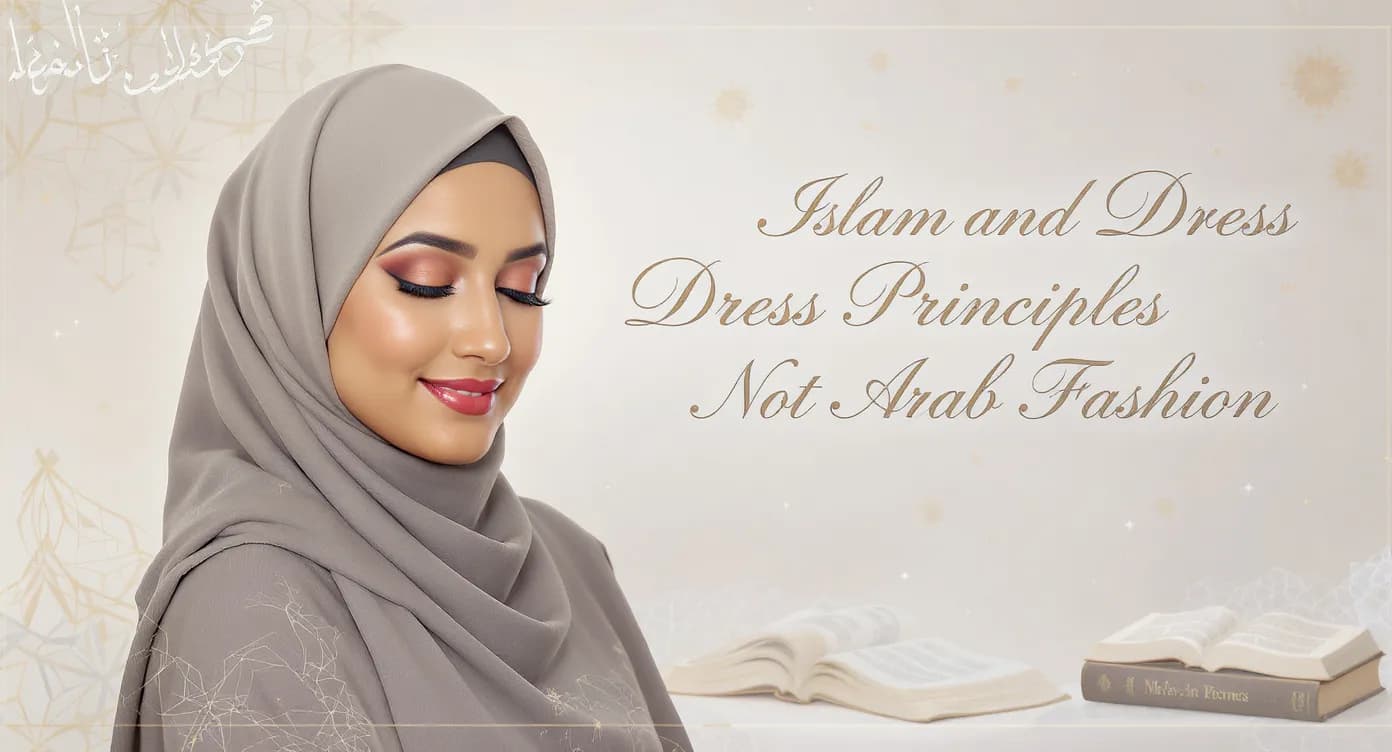
Islam and Dress: Principles, Not Arab Fashion
Many assume “Islamic dress” means Arab clothing—abaya, niqab, thawb, ghutra. In reality:
- The Quran speaks of:
- Modesty for both men and women
- Covering the ‘awrah (private parts)
- Avoiding tabarruj (showy display)
- It does not fix a single costume for all Muslims
- Classical scholars are clear: Islam does not obligate adopting “Arab clothes” specifically; what matters is coverage and modesty, not ethnicity of the fabric.
So hijab, niqab, burqa, abaya on the women’s side, or thobe, jubba, kurta, sherwani on the men’s side are cultural forms of a universal modesty ethic, not the only “Islamic” way to dress.
What Islam Says About Women’s Dress
The Quran establishes three core commands for Muslim women:
1. Lowering the Gaze and Guarding Chastity
“And tell the believing women to lower their gaze and guard their chastity…” (Quran 24:31)
Modesty starts from the heart and gaze, before cloth. Clothing is one part of a wider ethic of hayā’ (inner modesty).
2. Covering Adornment and Drawing the Khimar Over the Chest
“…and not to reveal their adornments except what normally appears. Let them draw their khumur (headcovers) over their chests…” (Quran 24:31)
Points from this verse:
- Women already wore headcovers (khimar) culturally
- The Quran refined it: extend the existing headcover to cover the bosom/chest
- Do not display adornment (jewelry + those body parts that attract attention) except to a defined circle of mahram relatives
This sets coverage and decency, not a particular cut or color. Scholars differ on details (face, hands, feet), but all agree on:
- Loose, non‑transparent, non‑provocative clothing
- Not designed to sexualize or display the body
3. The Outer Cloak (Jilbab) in Public
“O Prophet! Ask your wives, daughters, and the believing women to draw their jalabib (outer cloaks) over themselves. That is more suitable so that they will be recognized and not harassed.” (Quran 33:59)
Key ideas:
- Outer garment over normal clothes when in mixed/public spaces
- Aim: protection from harassment, clear signal of dignity and modesty
- Again: style is open—it could be abaya, long overcoat, manteau, long loose saree, etc.
Summary for Women
- Cover the whole body except what classical fiqh usually defines as face and hands (with differences of opinion)
- Clothes should be:
- Loose
- Thick (not see‑through)
- Not eye‑catchingly tight or designed to attract sexual attention
- No requirement that it must look “Arab”—Tamil, Malay, African, Turkish forms all valid if they meet the modesty conditions.
What Islam Says About Men’s Dress
Modesty is not only for women. The Quran first addresses men:
“Tell the believing men to lower their gaze and guard their modesty…” (Quran 24:30)
From Quran and Hadith, core rules for men:
- Cover the ‘awrah (navel to knee, as defined in Hadith‑based fiqh)
- Avoid:
- Tight, revealing clothes that expose shape of private parts
- Transparent fabrics
- Silk and gold for men (explicitly forbidden in sahih hadith)
- Clothing should not:
- Imitate distinctive religious dress of non‑Muslims (like priestly robes)
- Be worn purely for arrogance and showing off
Thobes, jubbas, kurtas, shirts, pants, veshti, lungi—all are acceptable if:
- ‘Awrah is covered properly
- Dress is modest and dignified
- No prohibited material (silk for men) or prohibited imitation
Dress and Culture: Islam Adopts, Refines, Not Erases
Islam historically entered many cultures—Arab, Persian, Indian, Malay, African, Turkish—and did not command them all to wear one uniform.
- In South Asia, modest salwar kameez and saree with proper pallau/headcover became “Islamic attire” for many women
- In Turkey, modest long coats and scarves
- In West Africa, flowing boubou and kaftan
- In Tamil Nadu, veshti, angavastram, pavadai‑daavani, saree—when worn modestly—can fully align with Islamic principles
Principle:
Islam sets boundaries; culture fills the space inside those boundaries.
- If a cultural dress violates:
- Coverage
- Modesty
- Gender boundaries
- Or clearly religious identity of another faith (e.g., priest collars, saffron monk robes)
→ Muslims should avoid it.
- Otherwise, local dress is welcome.
Dress and Landscape: Climate Shapes Clothing
Clothing is also a response to geography and climate:
- Desert Arabia:
- Loose, flowing garments (thobes, abayas)
- Light colors to reflect sun
- Head and face covering (for both men and women) against sand and heat
- Tropical Tamil Nadu:
- Lightweight cotton
- Veshti, saree, kachai, thin upper cloth in Sangam era
- Later, stitched garments as weaving advanced
- Cold regions:
- Layered coats, wool, thick hijabs, gloves, beanies
Islam’s rules are flexible enough to work in all these landscapes:
- Modesty + coverage + non‑transparency
- Within that, people adapt to temperature, work, and daily movement
Dress and Jobs: Function Matters
Different jobs require different dress, but modesty never switches off.
- Manual labor / farming:
- Need mobility, durability, breathable fabric
- Clothing can be simple, but still covers ‘awrah and avoids tightness
- Office/Professional work:
- Business suits, long skirts, professional salwar, long shirts—can all be modest if cut correctly
- Healthcare:
- Medical scrubs with lab coat
- For women, many use scrub + long over‑coat + suitable hijab style
- Security/Police/Military:
- Uniforms sometimes challenge modesty; Muslim personnel often push for slightly looser cuts or undershirts
Islam does not demand you give up your profession because of clothing; it asks you to adapt your clothing to fit both your job and your faith.
What Is a Modest Dress? Practical Checklist
From Quranic principles and fiqh, a practical modesty checklist:
For women (majority scholarly view):
- Covers entire body (except face & hands, with some differences)
- Fabric is opaque
- Clothing is loose enough not to outline the body
- Not deliberately sexy or attention‑seeking
- Not a distinctive symbol of another religion
- Avoids extreme extravagance and brand‑showing arrogance
For men:
- From navel to knee covered at minimum
- Preferably loose, opaque, dignified
- Avoids silk, gold, ultra‑tight clothes
- Avoids copying religious dress of non‑Muslims
The Quran’s own phrasing emphasizes decency, lowering the gaze, guarding private parts—clothes are a means to that ethical goal.
Do We Need “Freedom of Dressing”?
From a human rights and fiqh perspective:
- Coercive stripping or coercive veiling both violate human dignity
- True Islamic view emphasizes:
- Obedience to Allah
- Freedom from human tyranny, East or West
Muslim women should be free:
- To wear hijab/niqab without being banned, mocked, or excluded from jobs/universities (as in some European “burka bans”)
- To practice modesty as a personal act of worship, not as state spectacle
At the same time, from a Sharī‘ah standpoint, Muslims believe modest dress is obligation (fard), not just a lifestyle option, so discussions of “freedom” must balance:
- The right to practice faith publicly
- The responsibility of a believer toward Allah’s commands
Western Influence and Its Dark Side
Not all Western influence is negative—technology, law, some rights discourse are beneficial. But in dress and media, certain trends conflict with Islamic modesty:
- Hyper‑sexualization of both women and men in ads, movies, music videos
- Fashion that:
- Treats the body as a product
- Normalizes nudity as “confidence”
- Encourages comparison, insecurity, and body obsession
- “Freedom” is marketed as freedom to undress, not freedom from objectification
Research on “pious fashion” and diaspora Muslims shows many women consciously resist these norms by choosing modest dress as identity, faith, and agency—not as blind tradition.
How to Resist Unhealthy Western Fashion Pressure
-
Re‑center intention (niyyah)
- Dress for Allah, not for likes, brands, or trends
-
Curate social media
- Unfollow accounts that constantly sell body/skin as value
- Follow modest fashion, Islamic knowledge, and local cultural heritage pages
-
Build a modest wardrobe you actually like
- Practical, aesthetic, comfortable
- Mix local styles (saree, abaya‑style overcoat, long kurtis) with Islamic requirements
-
Community norms
- Masjids, madrasas, youth groups should teach modesty for both genders, not shame only girls
-
Learn the fiqh of dress
- Once someone understands why modesty matters (protection from harm, lowering fitnah, honoring one’s body), resistance becomes conviction, not mere habit.
Costumes of Tamilans: Sangam Literature and Modesty
Classical Tamil texts show a rich clothing culture long before Islam reached the region.
1. Everyday Dress and Textiles
Sangam literature records:
- Kalingam, Kachai, Udukai, Pattudai, Danai, Padam as types of garments
- Cotton weaving was advanced; garments are described as:
- Soft, fine, flower‑like (திருமலரன்ன புதுமடி – “broad flower‑like garment”)
- Men wore simple lower garments (veshti‑type), women wore draped upper/lower wraps that could be very modest when properly arranged
2. Purananuru 189 – Food and Clothing
Your referenced video on Purananuru 189 ([YouTube: 7x_Lq6A1-4k]) explains a poem where the poet speaks of the basics of life: eating and clothing as fundamental human needs, while still emphasizing dignity and simplicity.
- Clothing is portrayed as essential but not status‑obsessed
- This resonates with the Qur’anic teaching that garments are for covering nakedness and as adornment, but piety is better:
“O children of Adam, We have bestowed upon you clothing to conceal your nakedness and as adornment. But the clothing of piety—that is best.” (Quran 7:26)
3. Purananuru 274 – Neelak Kachchai (Blue Cloth)
The second video ([YouTube: PZHIDJft0Kk]) discusses Purananuru 274, where நீலக் கச்சை (blue waist‑cloth) symbolizes beauty and cultural refinement.
- Shows taste in color, drape, and presentation
- Again: clothing is a marker of culture, but not yet hyper‑sexualized
Islam can adopt such Tamil clothing—a neatly worn saree with proper coverage, for example, or a veshti with modest upper cloth—provided they meet modesty criteria.
4. Ainkurunuru 191 – Beauty and Dress
Your third reference ([YouTube: PMcUqwh_Prc]) touches Ainkurunuru, poem 191, with lines like:
கானல் ஞாழல் கவின்பெறு தழையள்,
வரையர மகளிரின் அரியளென்,
நிறையரு நெஞ்சம் கொண்டொளித் தோளே.
The poem praises a woman’s beauty using nature imagery (mirage, creeper, shoulders).
- Sangam love poetry often describes:
- Fine garments
- Ornaments
- Physical form
… but within a poetic and metaphorical frame, not crude description.
From an Islamic lens:
- Appreciating beauty is allowed
- But public, sensual display of the body for strangers (tabarruj) is discouraged
- Tamil Muslims can draw inspiration from the aesthetic refinement of Sangam poetry while filtering out elements that conflict with modesty.
Your YouTube links nicely show Tamil dress heritage; adding them in your blog:
1. Purananuru 189 – Food and dress philosophy

2. Purananuru 274 – Neelak Kachai (Blue cloth)

3. Ainkurunuru 191 – Beauty and costume

Download the App: Learn Quranic Guidance on Modesty in Tamil
To study Quranic verses about modesty, hijab, and ethics directly in Tamil and Arabic, use:
📱 Al-Quran Multilingual App
- Android: https://play.google.com/store/apps/details?id=jino.quran.app
- iOS/macOS: https://apps.apple.com/in/app/al-quran-multilingual/id6738510896
- Desktop: https://github.com/jinosh05/Al-Quran-Multilingual-Desktop/releases
- Web: https://alquranjino.online
Features:
- Multiple Tamil translations (Jan Turst Foundation, Abdulhameed Baqavi)
- Arabic‑Tamil side‑by‑side
- Fast verse search (e.g., 24:30‑31, 33:59, 7:26)
- Offline reading, bookmarks, and more
For Tamil Quran PDFs:
- Jan Turst Foundation:
https://alquranjino.online/books/tam_janturstfoundat/download_pdf - Baqavi:
https://alquranjino.online/books/tam_abdulhameedbaqa/download_pdf
Combined Arabic + Tamil view:
https://alquranjino.online/combined-quran
FAQ
Q1: Is hijab (headcover) explicitly mentioned in the Quran?
The word “hijab” in the Quran literally means barrier/screen, not scarf.
- Clothing verses use words like khimar (headcover) and jilbab (outer cloak) in 24:31 and 33:59.
- Scholars understand from these that covering the hair and body modestly is required, but cultures express this through different forms (dupatta, scarf, shawl, etc.).
Q2: Is niqab (face veil) compulsory?
Classical scholars differ:
- Some say face is ‘awrah, so niqab is required
- Others say face and hands can remain open, niqab is recommended or optional
All agree that: - A woman who covers head, body, and chest properly is fulfilling core modesty requirements.
Q3: Can a woman wear saree or salwar and still be Islamic?
Yes—if:
- Saree is draped to fully cover body and chest with non‑transparent material
- Salwar kameez is loose, long, and opaque
- She adds hijab over hair and chest as required by 24:31 So a “Tamil Muslim saree + hijab” can be as Islamic as an abaya.
Q4: Can a man wear T‑shirt and jeans?
Yes—if:
- Jeans are not tight to the point of outlining private parts
- T‑shirt covers to at least mid‑thigh or is paired with something that ensures the ‘awrah remains fully covered, and the look is dignified and modest.
Q5: Is it haram to wear “Western clothes”?
Not automatically. Scholars distinguish:
- Forbidden:
- Clothes exclusive to non‑Muslim religious identity (priest robes, monk outfits)
- Clothing clearly violating modesty (micro‑shorts, cleavage tops)
- Allowed:
- Neutral items (shirts, jackets, trousers) when worn modestly
Islam does not ask you to become an Arab; it asks you to become a modest, dignified servant of Allah in your own culture. A Tamil Muslim in a modest veshti and kurta, or a Tamil Muslimah in a well‑draped saree with hijab, can be fully “Islamic” while honoring Tamil identity.
The real question isn’t “Is this Arab enough?” but:
Does my dress reflect taqwa, modesty, and self‑respect in front of Allah and creation?

Jinosh Nadar
Founder of Al Quran Multilingual. Dedicated to making Islamic wisdom accessible.