A Labourer’s Day: A Story of Hard Work, Faith, and Hope
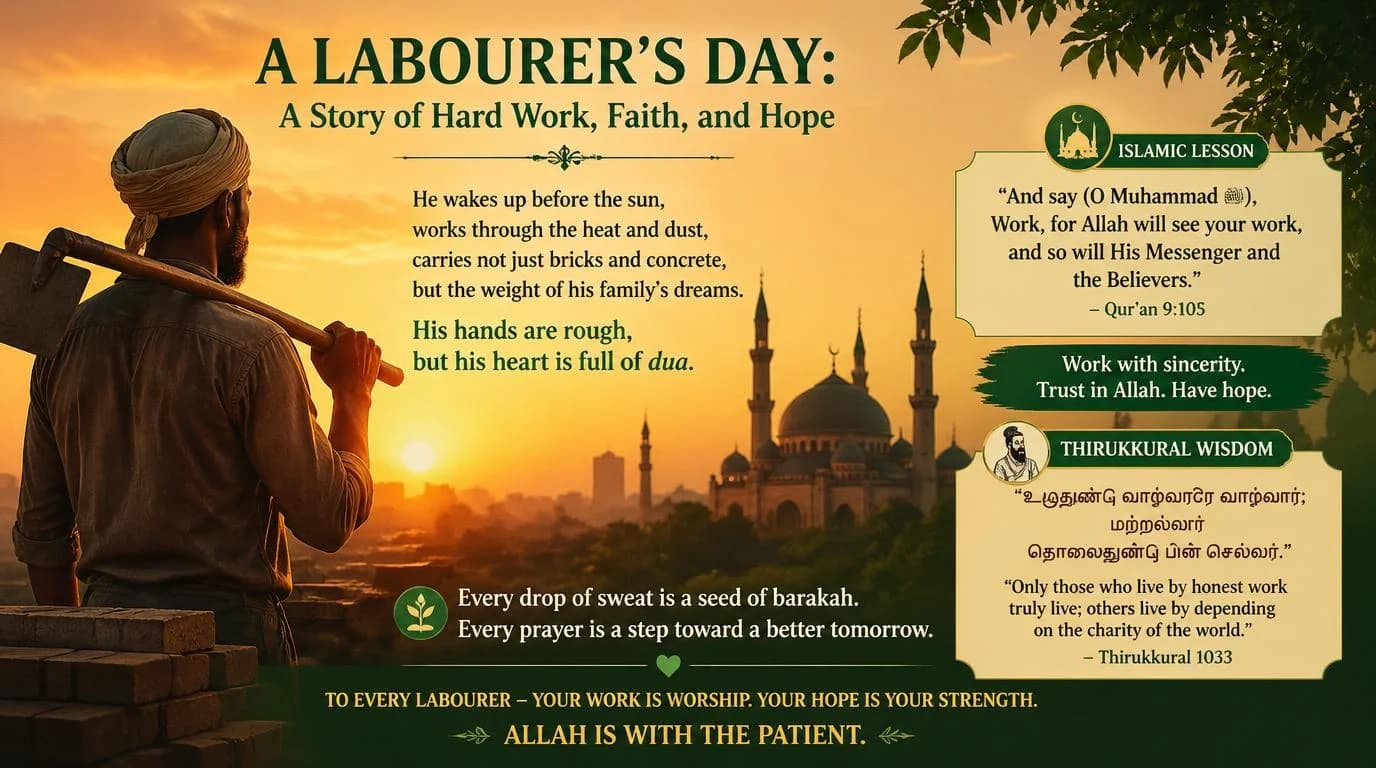
A Labourer’s Day: A Story of Hard Work, Faith, and Hope
Meta description: A heartfelt Labour Day story combined with Islamic and Thirukkural lessons about patience, work, and faith.
A Day in the Life of a Worker
The alarm rings at 4:30 AM.
For a moment, Imran lies still, listening. The fan hums above him, pushing warm Chennai air around the small rented room. Next to him, his two children sleep curled up near their mother, their school bags hanging carefully on a nail by the wall.
He slips out quietly, so their sleep isn’t disturbed.
A quick wudu from a plastic bucket. Fajr prayer on a thin mat that has seen better days. He stands, bows, and places his forehead on the ground, whispering the same dua he makes every morning:
“Ya Allah, give me halal work today. Keep my body strong, my iman stronger.”
By 5:30 AM, he is already at the tea stall near the main road. The owner knows him by name. One glass of hot chai, one small biscuit. That’s his breakfast. He checks his phone: no missed calls from the contractor, but he goes anyway. If you want work, you show your face. Every single day.
At the construction site, the labourers gather like always—some from the village, some from other states, some who know just enough Tamil or Hindi to manage a day’s work. The supervisor steps out with a clipboard, calls names. Every time he pauses, hearts skip a beat.
“Imran!” he finally calls.
Alhamdulillah. One more day of work.
The sun climbs. Cement sacks tear open, sand mixes with gravel, iron rods are dragged across the site. The city races by on the road outside, people in cars and bikes complaining about the heat. On the scaffold, under a helmet that never fits right, Imran doesn’t complain. He cannot afford to.
At 1 PM, he sits on a broken brick, opens his steel tiffin. Rice, a little sambar, a piece of pickle. Flies buzz around. He eats with the same gratitude as if it were a feast.
In the distance, the azaan from a small mosque just manages to reach the site. He whispers Bismillah again, silently promising himself that Asr and Maghrib he will catch in the masjid, no matter how tired he is.
As the day fades into sunset, dust sticks to his sweat, his back feels like it’s made of stone, and his hands are raw. Yet when he reaches home and his kids run to him shouting “Appa!”, he smiles as if the entire day was nothing.
Because for him, that hug is his real salary.
Struggles Behind Every Smile
On Labour Day, social media fills with quotes about workers, posters with helmets and gear, and corporate messages about “respecting all employees.” But behind the simple smile of someone like Imran, there is a world most people never see.
There is the rent that eats half his income.
There is the school fee that is always a little late, but which he insists on paying because he wants his children to live a different life.
There is the loan taken when his mother fell sick, which still hangs over him like a shadow.
There is the fear that one injury, one accident at the site, could push the whole family into a financial pit.
And yet, every morning, he wakes up and goes again.
He jokes with his co‑workers.
He buys a chocolate once a week for his daughter.
He pretends his body isn’t aching, so his wife doesn’t worry.
If you saw him in the bus, you might not notice anything special. But Allah sees every step, every drop of sweat, every quiet sigh held back so the children won’t hear.
It is easy to praise hard work when it belongs to someone else. It is harder to pause and really feel what that life is like. On this Labour Day, the challenge is not just to repost a quote, but to let the reality of these hidden struggles touch the heart.
✨ Find Peace in Quran – Start Reading Today
What Islam Teaches About Effort and Reward
Islam does not romanticize poverty, but it honours effort.
In Surah An‑Najm, Allah states a principle that applies directly to every labourer’s life:
“And that there is not for man except that [good] for which he strives.”
Quran 53:39
Read this verse
This verse tells us that a person is truly entitled only to the fruits of their effort. It is a Divine law: what you sincerely work for, especially in obedience and honesty, is seen by Allah and will be rewarded either in this world, the next, or both.
For someone like Imran, whose work is often invisible to society, this verse is like a secret promise:
“No effort you make is lost.”
Another powerful reassurance comes from Surah Ash‑Sharh:
“Indeed, with hardship comes ease.
Indeed, with hardship comes ease.”
Quran 94:5–6
Read this verse
The repetition is not a printing error—it’s emphasis. Scholars explain that Allah is guaranteeing that no difficulty is permanent, and that each hardship carries its own doors of ease, even if they’re not visible yet.
For the worker whose back hurts and whose salary is delayed, these ayahs are not theory. They are fuel.
- Every early morning shift.
- Every extra trip to the masjid even when tired.
- Every rupee sent to parents in the village.
All of it sits in his book of deeds, waiting to be repaid “with the fullest recompense.”
Thirukkural About Hard Work
Tamil wisdom stands right beside Quranic guidance in honouring effort over excuses.
குறள் 620 – Effort That Defeats Fate
ஊழையும் உப்பக்கம் காண்பர் உலைவின்றித்
தாழாது உஞற்று பவர்.
A simple meaning:
Those who work without fear or laziness, who do not give up, will see even “fate” fall behind them.
People often say, “ஊழு தான் முடிவு” – fate decides everything. But Tiruvalluvar turns that idea upside down: he says that those who persist, who refuse to sink into despair, can even make fate look back in surprise.
This is exactly the story of every labourer who fights statistics—poverty, lack of education, social barriers—and still pushes forward.

குறள் 611 – Don’t Say “This Is Too Hard”
அருமை உடைத்தென்று அசாவாமை வேண்டும்
பெருமை முயற்சி தரும்.
Meaning in simple Tamil:
“இது செய்வதற்கு அரும் (கடினம்)” என்று மனம் தளரக்கூடாது.
முயற்சி தானே அதைச் செய்யும் வலிமையையும் பெருமையையும் தரும்.”
In English:
Do not give up saying “this is too difficult”.
Steady effort itself will give you the strength and honour needed to complete it.
For a worker lifting bricks, driving an auto, cleaning streets, or delivering parcels, these couplets are like a Tamil echo of Quran 53:39: your effort is your dignity.
Not the brand of your phone. Not the letters after your name. The courage to keep working is itself a badge of honour.
Quranic Guidance for Everyday Life
Islam doesn’t separate “religious life” from “working life.” The same Quran recited in Taraweeh speaks directly to the hours spent at a construction site, in an office, or behind a shop counter.
A few simple reflections:
-
Effort is seen:
“And that his effort is going to be seen – then he will be recompensed for it with the fullest recompense.” (53:40–41)
Read this verse
Even if a boss doesn’t say “well done,” Allah does. -
Hardship isn’t endless:
“Indeed, with hardship comes ease.” (94:6)
Read this verse
Every difficult season carries seeds of future relief—skills gained, patience built, sins forgiven. -
Intention transforms work:
When a worker earns halal income to feed family, avoid debt, and give charity, his labour hours become hours of ibadah (worship) in Allah’s sight. -
Justice is part of faith:
The Quran praises those who “stand firmly for justice,” reminding employers and society that exploiting workers is a spiritual crime, not just a legal one.
So when we speak about Labour Day, we’re not talking about something separate from deen. We’re talking about an area where Islam already gave deep guidance more than 1,400 years ago.
Respecting Every Profession
One of the most beautiful things in both Tamil and Islamic tradition is the way they refuse to look down on honest work.
- Thirukkural honours the farmer and the worker as foundations of society.
- Islam reminds us that even prophets worked—herding animals, trading honestly, serving communities.
In real life, though, we sometimes treat people’s worth as if it is decided by:
- their English fluency,
- their job title, or
- their office location.
But try this thought experiment:
- Who built the very apartment you live in?
- Who laid the roads you drive on?
- Who cleans the hospital floor where your loved ones receive treatment?
- Who delivers your food in the rain?
We may not know their names, but our comfort is built on their effort.
Respecting every profession means:
- speaking politely to workers, security guards, drivers, and delivery people;
- paying fair wages and not delaying payment;
- teaching children to say “thank you” to everyone who serves them;
- never mocking someone’s job, income, or uniform.
In Allah’s scale, a labourer who prays on time, earns halal, and stays patient may be far higher than someone with a big salary and a hard heart.
✨ Find Peace in Quran – Start Reading Today
Let the Book that honoured effort and patience be your daily companion.
Download the App for Daily Inspiration
If you want daily reminders of these values—about hard work, patience, and trust in Allah—you can keep the Quran close wherever you are.
📱 Android – Al Quran Multilingual
https://play.google.com/store/apps/details?id=jino.quran.app
📱 iOS (iPhone / iPad / Mac)
https://apps.apple.com/in/app/al-quran-multilingual/id6738510896
🖥️ Windows / Linux / macOS (Desktop App)
https://github.com/jinosh05/Al-Quran-Multilingual-Desktop/releases
🌐 Web Version (with interlinked verses and translations)
https://alquranjino.online
You can:
- Read Quran 53:39 about effort and reward:
https://alquranjino.online/book/ara_quransimple/53/39 - Read Quran 94:5–6 about hardship and ease:
https://alquranjino.online/book/ara_quransimple/94/5
Use the app during your break, on the bus, or before sleeping:
- one short ayah,
- one moment of reflection,
- one step closer to the peace that keeps a worker’s heart strong.
Download the app for daily inspiration—and let every day be a Labour Day of meaning, not just of survival.

Jinosh Nadar
Founder of Al Quran Multilingual. Dedicated to making Islamic wisdom accessible.