Milad un-Nabi 2026 — The Birth That Changed the World
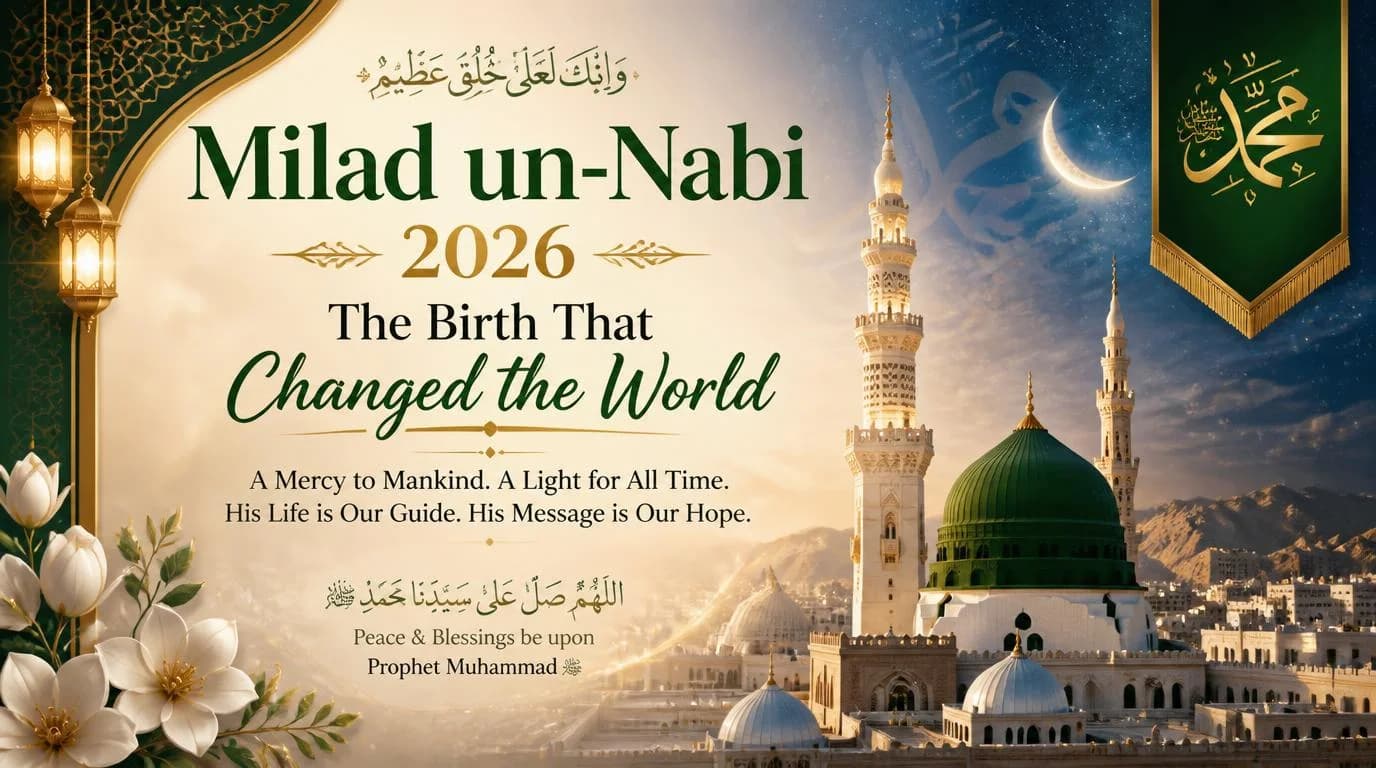
Milad un-Nabi 2026 — The Birth That Changed the World
What Does the Name Mean?
Milad un-Nabi breaks down simply:
- Milad / Mawlid — from the Arabic root walad: "to give birth" or "the time and place of birth"
- un-Nabi — "of the Prophet," referring to Prophet Muhammad ﷺ
Together: the birth of the Prophet. A name as straightforward as the man it honours — and as layered as the centuries of devotion that followed.
How the Celebration Began — A 1,300-Year Journey
The observance did not emerge fully formed. It grew across centuries, shaped by different rulers, each adding their own expression of love for the Prophet ﷺ.
8th–9th Century — Private and Quiet No public processions, no state ceremonies. Early Muslims honoured the day privately — reciting poetry, singing devotional songs, cooking meals — as personal acts of remembrance.
11th Century — The First Public Celebration The Fatimid Caliphate in Egypt formalised the first state-sponsored observance: public gatherings, Quran recitations, sermons, and the distribution of food and sweets to the people.
12th–13th Century — Adopted by Sunni Communities In Syria, the ruler Nur ad-Din Zangi organised early Sunni observances. In Iraq, Muzaffar al-Din Gökböri — the brother-in-law of Saladin — hosted massive, highly organised festivals with grand feasts, musical recitations, and enormous public crowds.
16th Century — An Official Holiday In 1588, the Ottoman Sultan Murad III declared Milad un-Nabi an official imperial holiday. The Ottomans lit mosques with lamps — a tradition that directly inspired the bright green light displays seen globally today.
Who Does Not Celebrate It — And Why
This is the part most blogs skip. Milad un-Nabi is observed by hundreds of millions globally, but several significant groups do not participate — not out of indifference, but sincere theological conviction.
Groups that do not observe it: Salafis and Wahhabis, major Deobandi scholars, the Ahl-i Hadith movement, and by official state policy — Saudi Arabia and Qatar.
Their core reasons:
1. Bid'ah — Religious Innovation Bid'ah refers to introducing new ritual worship not commanded by God or practiced by the Prophet ﷺ. The most-cited hadith: "Whoever introduces into this matter of ours that which is not from it, it will be rejected."
2. No Precedent from the Earliest Generations Neither the Prophet ﷺ, his Companions, nor the earliest jurists ever celebrated his birthday. If it were valid, they argue, those closest to him would have done it first.
3. Islam Has Only Two Official Festivals The Prophet ﷺ designated only Eid al-Fitr and Eid al-Adha. Adding a third — often called Eid Milad un-Nabi — is seen as compromising this structure.
4. Fear of Excessive Veneration A direct prophetic warning: "Do not exaggerate about me as the Christians exaggerated about the son of Mary." Critics worry birthday celebrations mirror Christmas traditions and risk blurring the line between love and worship.
5. True Love Is Daily Sunnah, Not an Annual Festival The most authentic expression of love is following his daily habits, lifestyle, and legal teachings (Sunnah) every single day — not a once-a-year ceremony.
This is a real and serious scholarly debate. Acknowledging it honestly is itself an act of intellectual respect for Islam.
Birthdays in Islam — Where Scholars Actually Stand
Islam has no unanimous ruling on personal birthdays. Scholars divide into two camps:
Prohibited or Discouraged — Conservative schools argue the practice imitates non-Muslim customs ("Whoever imitates a people is one of them"), has no Islamic precedent, and risks creating a personal third "Eid."
Permissible as Culture — Many mainstream scholars hold that birthdays are custom ('adat), not worship (ibadah). Worldly customs are permitted unless explicitly forbidden — provided the gathering is modest and free from forbidden elements.
The Prophet's Own Example: When asked why he fasted every Monday, the Prophet ﷺ replied: "That is the day on which I was born, and the day on which the Revelation was sent down to me." He marked the day — not with a feast, but with fasting and worship. This is the balance most scholars point to.
Milad un-Nabi in Tamil — Seerapuranam
Tamil Muslims carry their own extraordinary tradition of honouring the Prophet's birth.
Seerapuranam (சீரப்புராணம்) is an 18th-century Tamil Islamic epic poem by the poet Umaru Pulavar, narrating the life and birth of Prophet Muhammad ﷺ through the full classical forms and meters of Sangam-era Tamil poetry. It is one of the most powerful examples of Islamic devotion and Tamil literary heritage not just coexisting — but enriching each other completely.
📖 Seerapuranam — A Tamil Islamic Epic
What to Actually Do on This Day — Quranic Grounding
For those who observe Milad un-Nabi, the question is not just whether to mark the day but how to do so in a way rooted in scripture.
1. Send Blessings Upon the Prophet — Durood
The most universally agreed-upon act — supported even by scholars cautious about other observances — is reciting Durood and Salam. This is not custom. It is a direct Quranic command:
"Indeed, Allah and His angels shower blessings upon the Prophet. O you who have believed, ask [Allah to confer] blessings upon him and ask for him peace with all respect."
— Surah Al-Ahzab, 33:56
2. Rejoice in the Mercy That Was Sent
Supporters of Milad un-Nabi ground their celebration in the Quran's own description of the Prophet ﷺ:
"And We have not sent you, [O Muhammad], except as a mercy to the worlds."
— Surah Al-Anbiya, 21:107
"Say, 'In the bounty of Allah and in His mercy — in that let them rejoice; it is better than what they accumulate.'"
— Surah Yunus, 10:58
If his arrival is Allah's mercy made manifest, then rejoicing on this day is rejoicing over mercy itself.
3. Study His Life — Seerah
Mosques and families use this day to gather and study the Prophet's character: his patience, leadership, treatment of the poor, the stranger, the enemy. The Quran gives a practical instruction:
"There has certainly been for you in the Messenger of Allah an excellent pattern for anyone whose hope is in Allah and the Last Day and [who] remembers Allah often."
— Surah Al-Ahzab, 33:21
Reading his biography is not sentiment — it is following a blueprint.
4. Feed the Poor — Sadaqah
The most tangible and universally praised act. The Prophet ﷺ spent his life defending orphans, widows, and the destitute. Feeding people in his memory is the most direct way to be what he taught:
"And they give food in spite of love for it to the needy, the orphan, and the captive, [Saying], 'We feed you only for the countenance of Allah. We wish not from you reward nor gratitude.'"
— Surah Al-Insan, 76:8-9
No ceremony, no procession, no decoration comes close to this in weight.
💻 Know Your Prophet Through His Book
The best way to honour Milad un-Nabi is not to celebrate it once a year and forget — it is to read the Book he was sent with, every day, in a language you actually understand.
Al-Quran Multilingual — free, ad-free, available in 90+ languages including Tamil, Arabic, and English:
- 📱 Android: Download on Play Store
- 🍎 iOS/macOS: Download on App Store
- 🖥️ Desktop: Download on GitHub

Jinosh Nadar
Founder of Al Quran Multilingual. Dedicated to making Islamic wisdom accessible.