Mullivaikkal Remembrance Day: A Story of Loss, Resistance, and the Demand for Justice
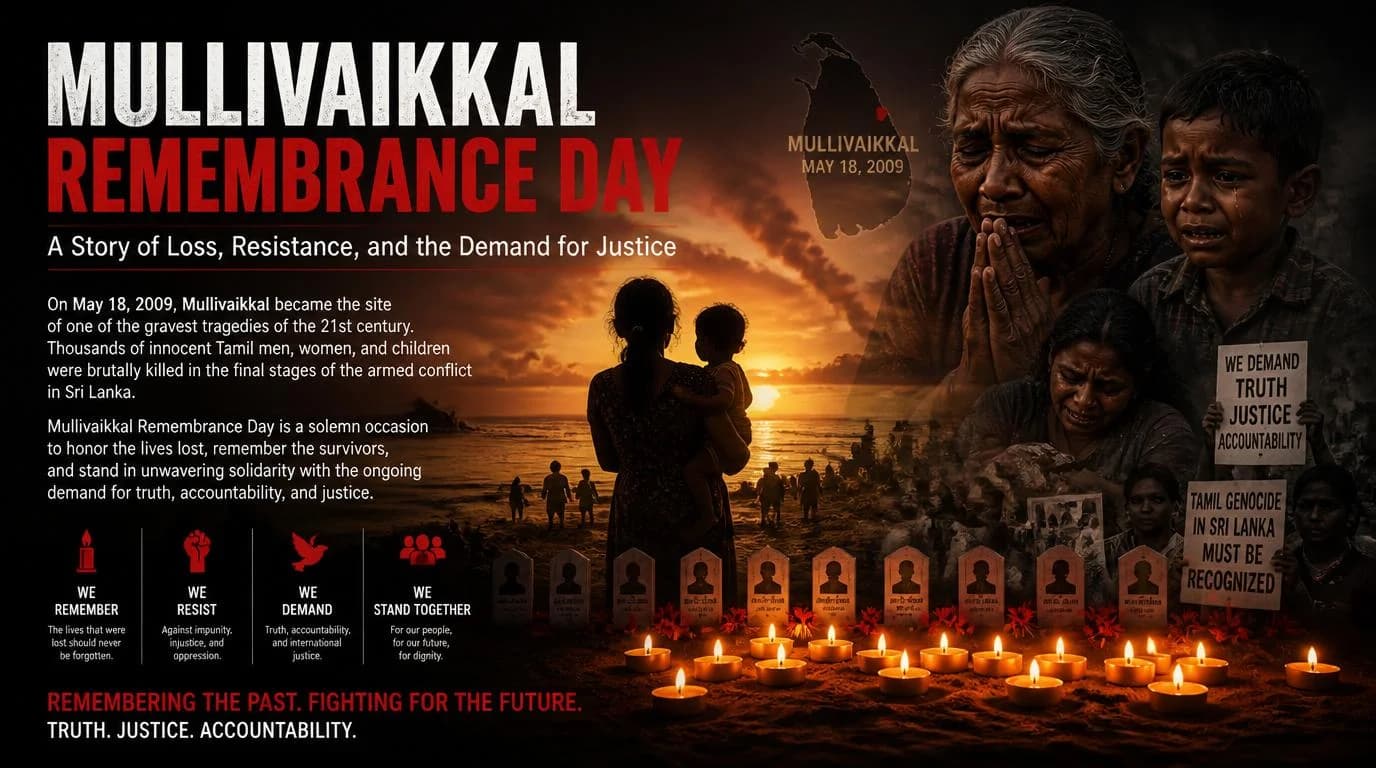
Mullivaikkal Remembrance Day is not just a date on the calendar. It is a wound in memory, a collective grief carried by families, and a reminder that history can become unbearable when justice is delayed for too long. For Tamils everywhere, May 18 is a day to remember the dead, the missing, the displaced, and the survivors who continue to live with the weight of what happened in Sri Lanka’s final war years.
This remembrance matters because the story is not only about war. It is about identity, denied rights, broken promises, betrayal, state violence, and the long silence that followed. It is also about the moral demand that suffering must not be erased simply because it is politically inconvenient.
A Hidden Genocide
The word “genocide” carries enormous weight, and whether every person uses that exact legal term or not, the pain behind the claim is real: many Tamils believe the violence and denial they faced amounted to a systematic destruction of their people, dignity, and future. Tamil people, even though they are a significant minority in Sri Lanka, have long said that their rights were denied despite their historical contribution to the country and the sacrifices made during the fight against British rule.
The tragedy did not begin in 2009. It was the outcome of decades of discrimination, broken political agreements, language imbalance, and escalating ethnic conflict. By the time the war reached its final stage, ordinary civilians had already paid a terrible price.
The hidden nature of the suffering matters. A tragedy becomes easier for the world to ignore when the victims are marginalized, when the survivors are displaced, when records are incomplete, and when the dead cannot speak for themselves. That is why remembrance is a moral act: it refuses to let silence become the final verdict.
History of the Conflict
The Sri Lankan civil war began in 1983 and lasted until 2009. At its core, it was a conflict between the government and the LTTE, but the roots of the war were deeper than military confrontation. They included ethnic tensions, political exclusion, language inequality, land disputes, discrimination, and a long sense among Tamils that they were being pushed aside in the land where they had lived for generations.
Over time, the conflict hardened. Peace efforts failed repeatedly. Suspicion replaced dialogue. Violence became normalized. By the final years, the war had become a brutal cycle in which civilians were trapped between state forces and insurgent forces, with little protection.
The final offensive, especially in 2008 and 2009, is remembered by many as the most devastating phase. Families were pushed into shrinking safe zones. Hospitals were reportedly hit. Food supplies were restricted. Communication collapsed. And thousands of civilians remained trapped in an increasingly impossible situation.
Casualties and Displacement
The scale of human loss is one reason Mullivaikkal Remembrance Day remains so powerful. Casualty estimates vary, but the commonly cited figures are staggering.
- Total deaths across the civil war are often estimated in the range of 80,000 to 100,000 or more, including both civilians and combatants.
- In the final phase alone, United Nations-related estimates have pointed to up to 40,000 civilian deaths in just the last months of fighting.
- Other assessments suggest that 70,000 or more people may have been unaccounted for during the final offensive.
- At its peak, the war displaced over 800,000 people.
- By 2020, then-President Gotabaya Rajapaksa acknowledged that more than 20,000 missing people from the conflict period were dead.
These are not just numbers. Each figure represents a face, a name, a family meal interrupted forever, a child who never returned home, a parent who kept waiting, and a community whose structure was shattered.
Displacement is its own kind of trauma. A person may survive physically and still lose the world they knew. A refugee tent, a temporary camp, or a borrowed room can never fully replace a home that was destroyed or abandoned under fire.
The Final Phase
The final phase of the war became especially tragic because civilians were increasingly trapped inside the conflict zone. Many accounts describe a situation where people had no real exit, no safe pathway, and no dependable protection. That is what makes the end of the war so morally painful for survivors and observers alike: the closer the violence moved to its conclusion, the more civilians appeared to be consumed by it.
When hospitals become unsafe, when food and medicine become scarce, and when movement becomes impossible, war stops being only a battle between armies and becomes a catastrophe for humanity itself. The people at Mullivaikkal were not statistics in a military report. They were families trying to survive.
The memory of the final months is therefore not only about death. It is about helplessness, waiting, fear, and the collapse of all ordinary life. Remembrance is the least the dead deserve.
Cause of the War
The Sri Lankan civil war did not arise overnight. It emerged from a long chain of political decisions, ethnic grievances, failed reforms, and growing distrust between communities. Tamils often felt increasingly excluded from state power, public institutions, and fair treatment under the law.
The issue was not merely emotion or perception. It was tied to concrete realities:
- unequal access to political influence,
- language and education struggles,
- discrimination in employment and administration,
- land and security concerns,
- and the failure of successive governments to build durable trust.
When the law says one thing but reality does another, people begin to lose faith in the system. That gap between legal promise and lived experience is often where conflict begins. In Sri Lanka, many Tamils felt that the law existed in theory, but reality hit them with delay, suspicion, restriction, and violence.
That is why this remembrance cannot be reduced to a simple “war ended” narrative. The causes were structural, and the consequences were human.
Law and Reality
One of the most painful aspects of the Sri Lankan conflict is the distance between legal order and actual experience. A nation may speak of rights, equality, citizenship, and peace, yet if people continue to live under fear, surveillance, exclusion, or direct violence, then law becomes hollow.
For many Tamils, the lived reality was not one of equal belonging. It was a reality of checkpoints, displacement, militarization, disappearances, and uncertainty. Even when the war ended, the feeling that justice had not arrived remained.
This is why remembrance is not nostalgia. It is a critique. It asks whether a country can call itself peaceful if the victims are still waiting, if the missing remain unaccounted for, and if accountability has not been delivered.
Were the Criminals Punished?
This question remains one of the central moral and legal wounds of the conflict.
Many observers and rights organizations have argued that accountability has been weak, delayed, or blocked. The claim is that despite repeated reports of killings, rape, torture, arbitrary detention, and attacks on civilians, senior officials and military figures were never properly punished. In many cases, alleged perpetrators remained in power or retained influence.
That failure matters because impunity teaches the wrong lesson. If violence is not investigated, if command responsibility is ignored, and if victims are left without justice, then the system signals that some lives matter less than others.
International legal efforts have tried to address this gap. Human rights groups and legal organizations have pursued documentation, witness support, and pressure for prosecution. But for many families, these efforts still feel far too small compared to the scale of what they lost.
Justice delayed is not only justice denied. In mass atrocity cases, delay can become a second violence.
Mullivaikkal as Memory
Mullivaikkal has become more than a place name. It is a symbol of final suffering, civilian vulnerability, and the demand that the dead be remembered honestly. For Tamils around the world, it stands for a truth that cannot be buried under political statements or diplomatic language.
Remembrance days matter because time alone does not heal injustice. Time can pass while grief remains unchanged. Children grow up hearing stories of what was lost. Parents age while waiting for answers. Communities continue to organize memorials because memory itself becomes a form of resistance.
To remember Mullivaikkal is to say that the victims were not expendable, that their lives were not collateral damage, and that history must not be rewritten by those in power alone.
Quran Condemns Inequality
The Quran strongly condemns oppression, arrogance, and injustice. Its moral vision is clear: no group should be allowed to dominate another through cruelty, and no society can remain upright if it normalizes the humiliation of the weak.
One powerful principle is that Allah does not love wrongdoing or transgression. The Quran repeatedly commands justice, fairness, and protection of the oppressed. In this sense, the suffering of civilians in Sri Lanka stands in direct opposition to Quranic ethics, because indiscriminate violence, ethnic humiliation, and abuse of power are all forms of corruption on earth.
The Quran also teaches that humans were created in diversity so that they may know one another, not destroy one another. Any system that turns identity into a reason for exclusion violates this divine vision.
For remembrance, this matters deeply:
- oppression is condemned,
- the oppressor is not morally safe,
- and the silent suffering of the weak is not invisible to God.
From a Quranic lens, a state or community cannot claim righteousness while denying dignity to a people. Justice is not optional. It is a command.
Quranic Reflection on Oppression
The Quran does not treat oppression as a minor social issue. It treats it as a moral crime that damages individuals, families, and entire civilizations. Time and again, the Quran commands believers to stand firmly for justice, even when it is difficult, and even when the oppressed belong to a community that the powerful would rather ignore.
One of the strongest verses on justice is:
“O you who believe! Stand firmly for justice, as witnesses for Allah, even if it be against yourselves or your parents or relatives.”
Quran 4:135
https://alquranjino.online/book/ara_quransimple/4/135
This verse is powerful because it removes favoritism from justice. A believer is not allowed to protect the wrongdoer simply because they are family, powerful, or familiar. Justice must remain above personal loyalty.
Another central verse says:
“O you who believe! Be persistently standing firm for Allah, witnesses in justice, and do not let the hatred of a people prevent you from being just. Be just; that is nearer to righteousness.”
Quran 5:8
https://alquranjino.online/book/ara_quransimple/5/8
This verse is especially important in conflict situations. It teaches that anger, grief, or historical pain must never turn into blindness. Even when a community has suffered deeply, the standard remains justice, not revenge.
The Quran also gives a direct command against social injustice:
“Indeed, Allah commands justice, good conduct, and giving to relatives and forbids immorality, bad conduct, and oppression.”
Quran 16:90
https://alquranjino.online/book/ara_quransimple/16/90
This verse shows that oppression is not just a political failure. It is a moral corruption that Allah openly forbids. Justice is not optional in Islam; it is part of the faith itself.
And the Quran explicitly gives voice to the oppressed:
“And what is wrong with you that you fight not in the cause of Allah and for the oppressed among men, women, and children who say: ‘Our Lord, take us out of this land of oppressive people and appoint for us from Yourself a protector and appoint for us from Yourself a helper.’”
Quran 4:75
https://alquranjino.online/book/ara_quransimple/4/75
This verse gives dignity to the cry of the weak. It recognizes that oppressed people do not only suffer physically; they suffer because they have been trapped in a system where protection has failed them.
Sangam Literature on Suffering, War, and Social Responsibility
Sangam poetry often links personal grief, social order, and the ethics of leadership. The three poems below vividly portray how war, oppression, and destructive leaders ravage land and people — themes that resonate with the memory of Mullivaikkal.
-
புறநானூறு 16 — “செவ்வானும் சுடுநெருப்பும்!” (Purananuru 16) — Pandarang Kannanar
Summary and reflection: This poem describes a devastating, almost apocalyptic raid: a conquering leader whose scorched-earth tactics burn houses and groves, ruin cultivated fields, and leave villages desolate. The poet’s image of the sky reddening like a sun obscured by smoke captures the moral horror of leaders who prize conquest over human life and livelihood. For a remembrance of Mullivaikkal, this poem is a literary mirror: when war treats civilian spaces as expendable, culture and survival both become casualties.
-
புறநானூறு 72 — “இனியோனின் வஞ்சினம்!” (Purananuru 72) — Pandiyan Thalaiyalankaanathuch (or attributed poet)
Summary and reflection: This poem laments the failure of rulers and the injustice that leaves loyal subjects abandoned. The speaker fears losing honor and support when rulers cease to protect their people. In the context of Mullivaikkal, the poem’s concern about leadership that abandons duty and the resulting suffering of ordinary people is especially resonant: political promises without protection become moral betrayals.
-
புறநானூறு 46 — “அருளும் பகையும்!” (Purananuru 46) — Govur Kilaar
Summary and reflection: This poem depicts a leader who, witnessing the cries of the helpless, chooses compassion and halts violence — an ethical counterpoint to the previous two poems. It celebrates the ruler who stops slaughter and protects the vulnerable. Placed next to Purananuru 16 and 72, this poem underscores that moral agency is possible: leaders can either magnify suffering or prevent it. Mullivaikkal’s memory compels a choice between forgetting atrocity and insisting that leaders act humanely.
Together, these Sangam poems form a three-part moral drama: the aggressor who destroys, the ruler who abandons, and the leader who could have protected the weak. Their inclusion in the remembrance blog provides cultural and classical testimony that Tamil literature has long valued protection of life, justice, and humane rule — values violated in the tragic years that Mullivaikkal commemorates.
Why Remembrance Matters
Remembrance is not simply about mourning. It is about preventing erasure.
If the dead are not remembered, their deaths become easy to deny.
If the missing are not named, they become easier to forget.
If survivors are told to move on without justice, then peace becomes another word for silence.
Mullivaikkal Remembrance Day asks something harder than sympathy. It asks responsibility. It asks whether the world has the courage to face atrocity without excuses.
For Tamils, remembrance is also identity. It says: we were here, we suffered, and we will not let the truth disappear.
Closing Reflection
Mullivaikkal is a place of grief, but also of moral clarity. It reminds us that state power without accountability can become monstrous, that rights denied for too long can produce catastrophe, and that memory is a duty when justice fails.
The dead deserve remembrance. The missing deserve answers. The survivors deserve dignity. And the world deserves the truth.
To remember Mullivaikkal is to refuse silence. It is to say that human life cannot be reduced to statistics, that Tamil suffering cannot be erased, and that the demand for justice does not expire with time.
Read the Quran
For readers who want to reflect spiritually on justice, oppression, mercy, and truth, the Quran can be read through Al Quran Multilingual:
Android:
https://play.google.com/store/apps/details?id=jino.quran.app
iOS:
https://apps.apple.com/in/app/al-quran-multilingual/id6738510896
Desktop:
https://github.com/jinosh05/Al-Quran-Multilingual-Desktop/releases
You can explore verses on justice, patience, and standing against oppression directly in the app and read them in multiple languages for deeper reflection.

Jinosh Nadar
Founder of Al Quran Multilingual. Dedicated to making Islamic wisdom accessible.